

Claus Mattheck’s Biomechanical Theory, Visual Tree Assessment, and Their Application to Urban Tree Management in Greater Sydney
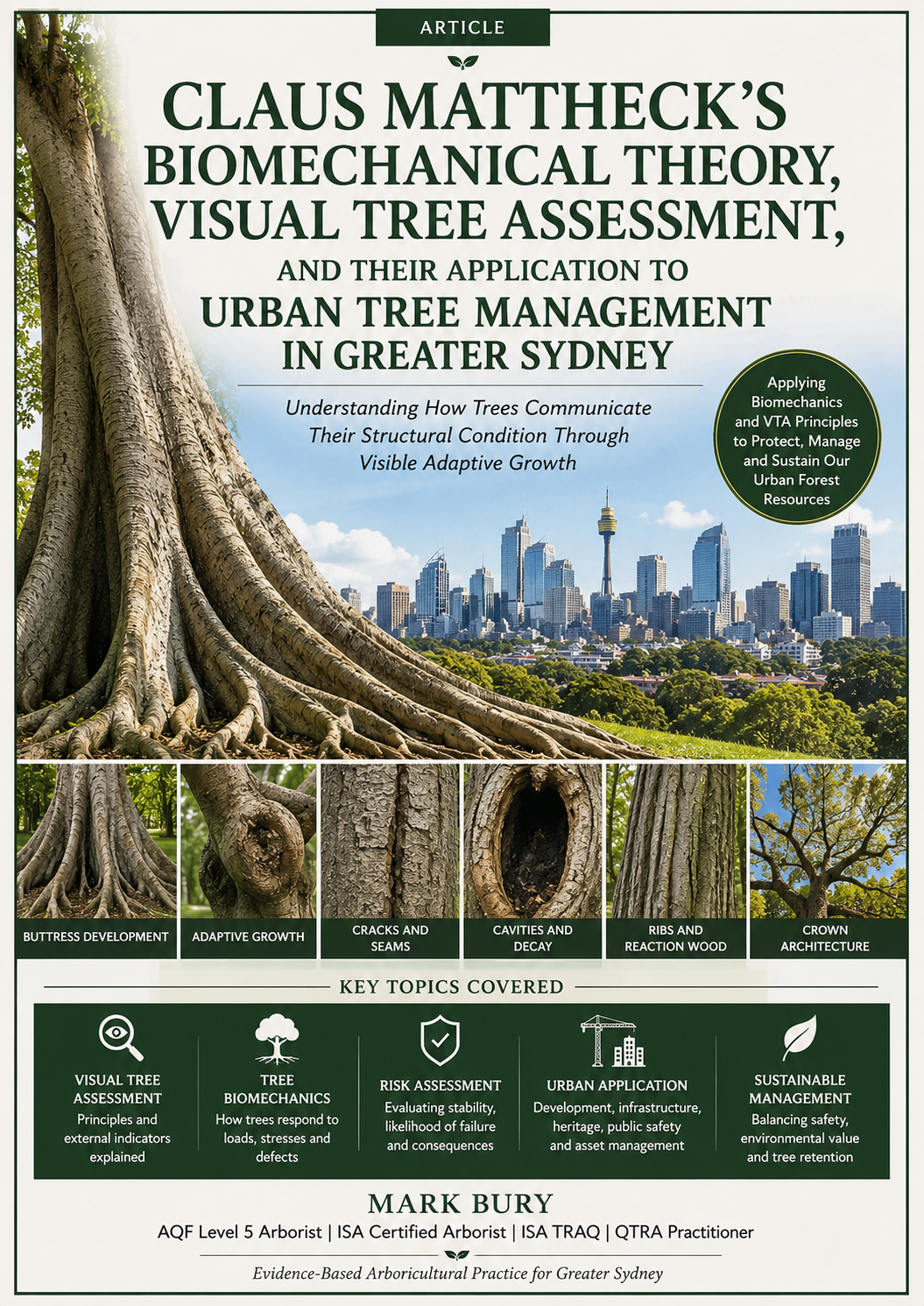
Claus Mattheck's Biomechanical Theory, Visual Tree Assessment, and Their Application to Urban Tree Management in Greater Sydney examines how modern tree biomechanics has transformed the assessment and management of urban trees. Based on the pioneering research of Dr. Claus Mattheck, the article explains how trees continuously adapt their form in response to mechanical loading, environmental stresses, and structural defects. These adaptive growth responses provide visible clues that allow experienced arborists to assess internal conditions without invasive investigation.
The article explores the scientific principles underpinning Visual Tree Assessment (VTA), demonstrating how external indicators—including adaptive growth, buttressing, bark abnormalities, cracks, cavities, bulges, ribs, reaction wood, and crown architecture—can be interpreted to evaluate structural integrity, stability, and the likelihood of failure. It also discusses the strengths and limitations of VTA and its integration with advanced diagnostic techniques where appropriate.
Particular emphasis is placed on the application of these principles within Greater Sydney's unique urban environment, where trees are influenced by development, infrastructure, drought, severe storms, soil constraints, bushfire considerations, and changing climatic conditions. The article explains how biomechanical theory informs arboricultural inspections, tree risk assessments, development planning, asset management, heritage tree conservation, and long-term urban forest management.
Drawing upon internationally recognised arboricultural science, Australian Standards, and practical experience, this article bridges research with professional practice. It provides consulting arborists, local government officers, engineers, planners, landscape architects, students, and tree managers with a practical understanding of how biomechanical principles and Visual Tree Assessment contribute to evidence-based decision-making, helping balance public safety, environmental sustainability, and the retention of valuable urban trees throughout Greater Sydney.