

Arboricultural Impact Assessment (AIA)
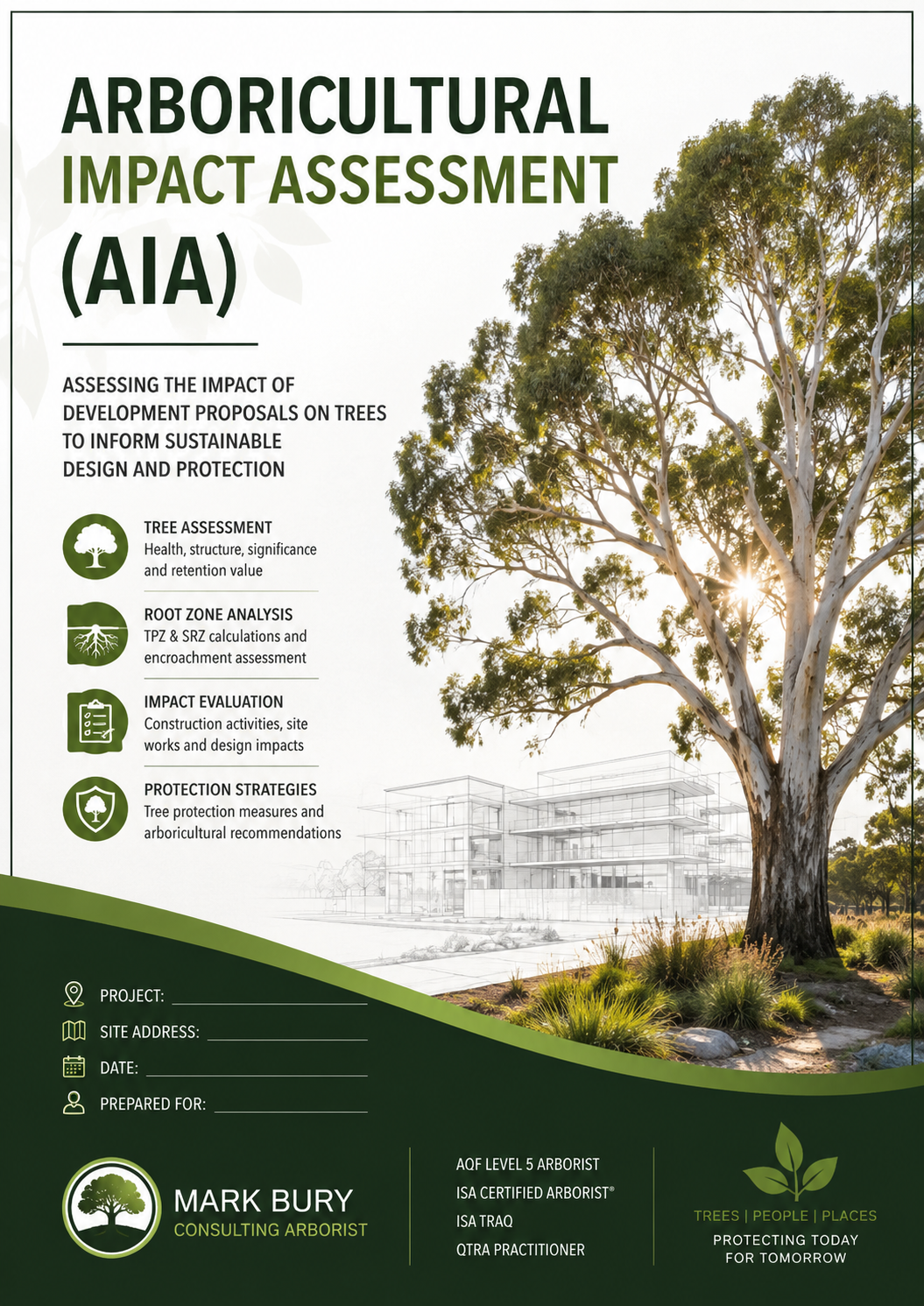
An Arboricultural Impact Assessment (AIA) is a technical report prepared by a suitably qualified arborist to evaluate how a proposed development may affect trees located on, adjoining, or close to a development site. Its primary purpose is to ensure that trees are properly considered during planning and design and that trees suitable for retention can be protected throughout construction.
The assessment typically identifies tree species, dimensions, age class, health, structural condition, landscape significance and retention value. It establishes each tree's Tree Protection Zone (TPZ) and Structural Root Zone (SRZ) and examines potential impacts from buildings, excavation, retaining walls, driveways, services, drainage, changes in soil levels, demolition and construction access.
In Australia, an AIA should generally apply the principles of AS 4970, Protection of Trees on Development Sites, together with relevant planning controls and accepted arboricultural practice. Encroachment into TPZs is assessed to determine whether impacts are minor, major or potentially unacceptable and whether design modifications or specialised construction methods are required.
Importantly, an AIA is more than a tree inventory. It provides an evidence-based assessment of the relationship between the proposed development and existing trees. Recommendations may include tree retention or removal, design amendments, root investigations, sensitive excavation, pruning, tree protection fencing, ground protection and arboricultural supervision.
A well-prepared AIA allows architects, planners, engineers, developers and consent authorities to make informed decisions while balancing development objectives with the sustainable retention and protection of valuable trees.