

Plant Assessment and Tree Valuation Systems
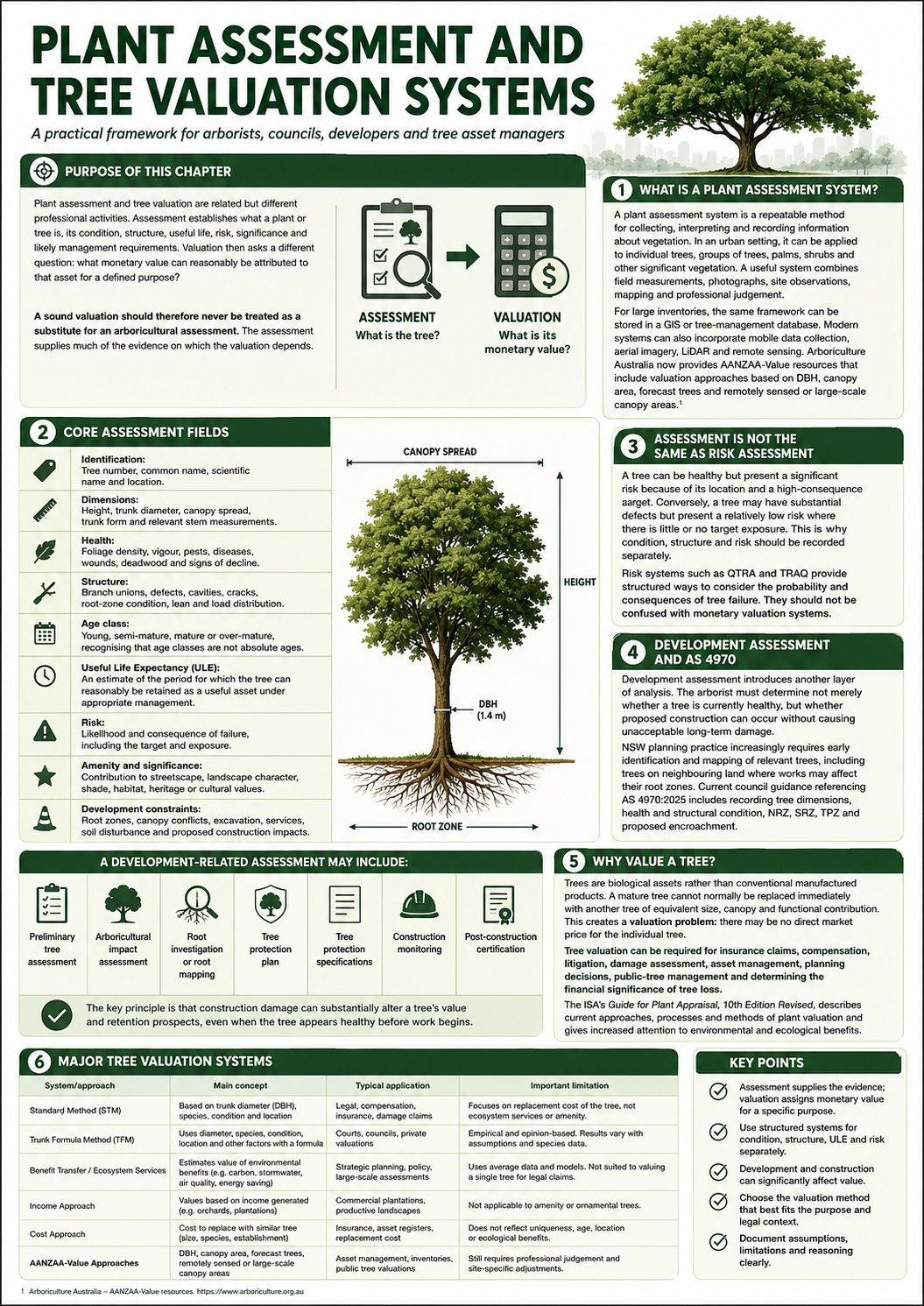
Plant Assessment and Tree Valuation Systems provides a practical framework for evaluating the condition, significance, risk, useful life expectancy and monetary value of trees within urban and developed environments. It brings together recognised arboricultural assessment methods to support consistent, transparent and defensible tree-management decisions.
The assessment process considers tree species, dimensions, age class, physiological condition, structural integrity, defects, growing environment and site constraints. Visual Tree Assessment (VTA) principles assist in identifying structural symptoms and potential failure mechanisms, while systems such as SULE/ULE, TRAQ and QTRA provide complementary approaches for considering retention value, useful life expectancy and tree-related risk.
Tree valuation extends the assessment beyond physical condition by recognising the broader contribution of trees to the landscape. Factors may include amenity, canopy cover, environmental services, habitat, heritage or cultural significance, location, prominence, replacement potential and the costs associated with establishing an equivalent landscape asset. Valuation methods should therefore be applied with professional judgement rather than treated as purely mathematical calculations.
An important principle is that tree condition, risk, retention value and monetary value are separate considerations. A large or valuable tree is not automatically suitable for retention, while a structurally compromised tree may continue to provide substantial environmental and landscape benefits requiring careful management.
Used together, plant assessment and tree valuation systems provide arborists, councils, developers, property managers and courts with an evidence-based foundation for balancing tree preservation, public safety, development impacts, asset management and long-term urban forest sustainability.