

Guidelines for Tree Protection Plans
Guidelines for Tree Protection Plans
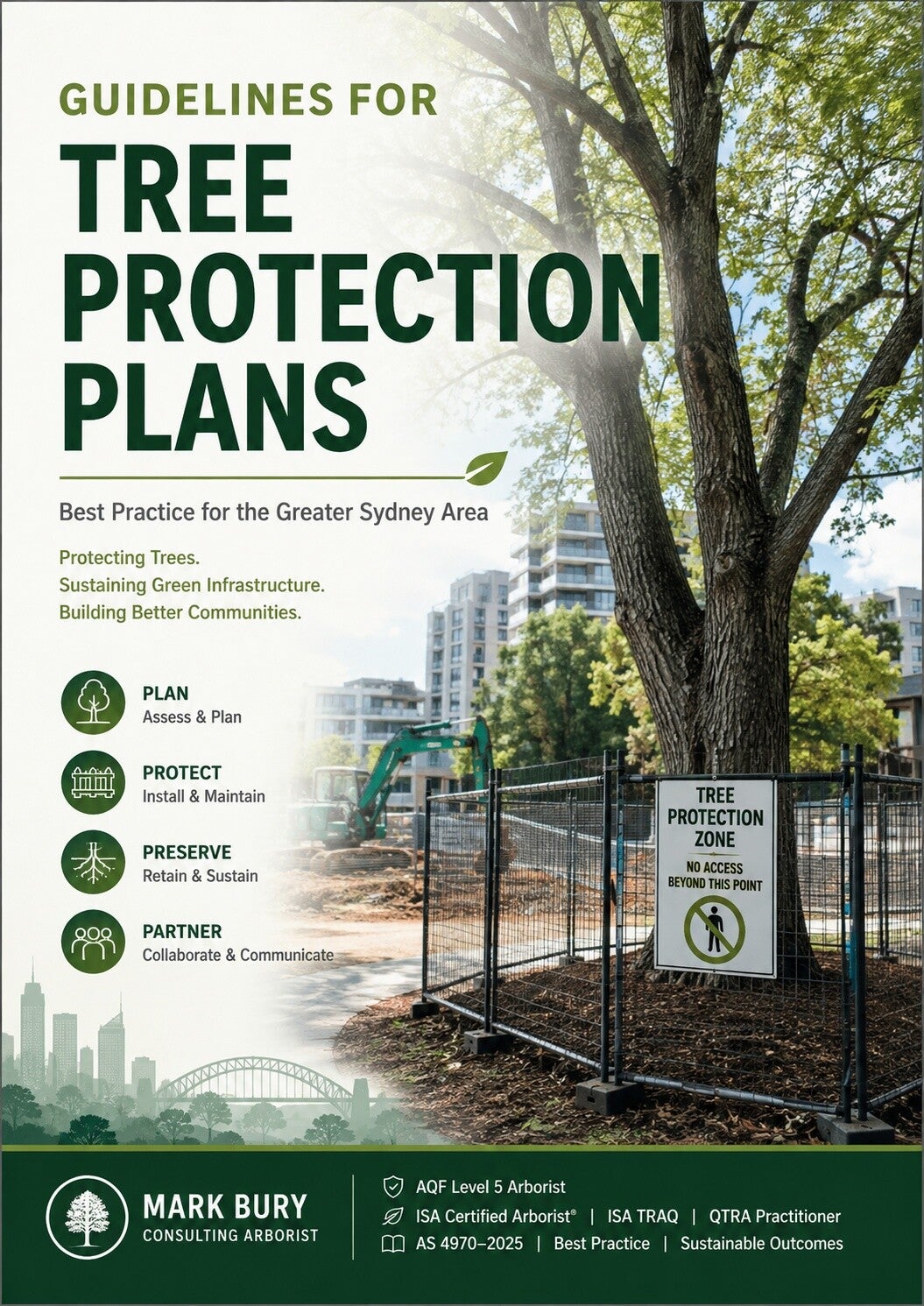
Guidelines for Tree Protection Plans provides a practical framework for protecting trees throughout development and construction projects. The article explains that successful tree retention requires more than placing temporary fencing around a trunk. Effective protection begins during the design stage and continues through demolition, excavation, construction, landscaping and final site establishment.
The article examines the principles of AS 4970, Protection of trees on development sites, including the identification of the Tree Protection Zone (TPZ) and Structural Root Zone (SRZ). It discusses how arborists should assess proposed encroachments and consider excavation, changes in soil levels, services, drainage, access routes, material storage and construction activities that may affect retained trees.
Particular attention is given to preparing clear and workable Tree Protection Plans (TPPs) showing tree locations, protection zones, fencing, trunk protection, ground protection, designated access areas and areas requiring arboricultural supervision.
The article also emphasises the importance of hold points and compliance inspections. Critical activities such as demolition near trees, excavation within TPZs, root pruning and installation of underground services should be inspected or supervised by a suitably qualified project arborist.
Importantly, tree protection is presented as a continuing management process rather than a single drawing prepared for development approval. Responsibilities must be clearly communicated to builders, contractors and consultants.
Ultimately, effective Tree Protection Plans integrate arboriculture with design and construction, allowing development to proceed while maintaining the health, structural stability and long-term viability of trees identified for retention.