

Observational Paper of Urban Tree Storm Damage April 2015 on The Central Coast of New South Wales and the Sydney Metropolitan Area
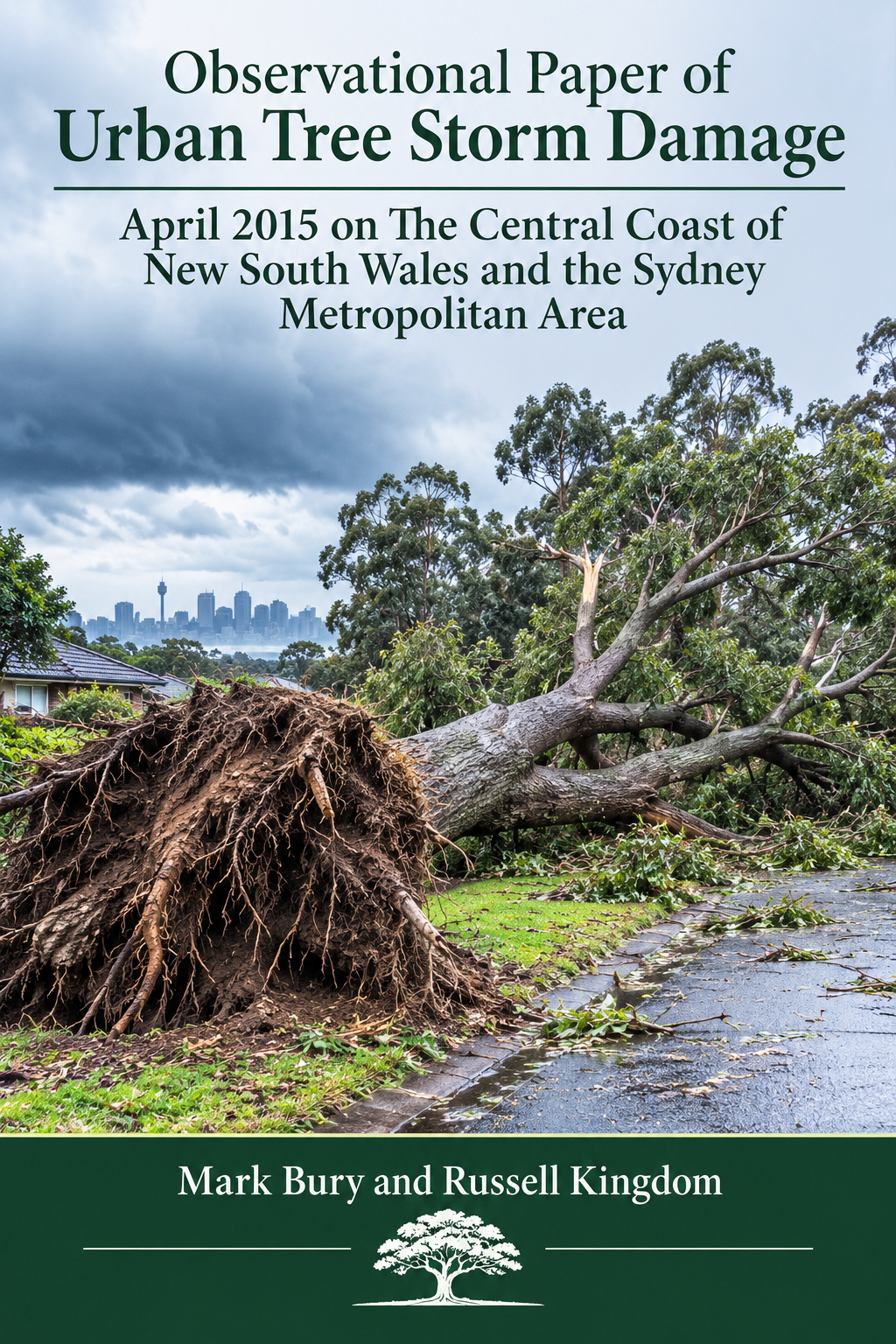
In April 2015, one of the most significant storm events to affect New South Wales in recent decades caused widespread damage across the Central Coast and Sydney Metropolitan Area. Thousands of urban trees failed under the combined effects of destructive winds, intense rainfall and saturated soils, resulting in extensive damage to homes, vehicles, roads, power infrastructure and public open spaces. The event also provided a rare opportunity to study how and why urban trees fail during extreme weather.
Observational Paper of Urban Tree Storm Damage presents a detailed field-based investigation of the storm's impact on the urban forest. Drawing on extensive site inspections undertaken immediately after the event, Mark Bury and Russell Kingdom document patterns of tree failure, species performance, structural defects, root plate failures, branch failures, stem failures and the influence of soil conditions, previous management and construction activities on tree stability.
Rather than focusing solely on individual tree failures, the paper examines the interaction between tree biology, biomechanics, site conditions and weather extremes, providing valuable insights into the factors that contribute to storm-related failures in Australia's urban environments. The observations are supported by contemporary arboricultural principles, engineering concepts and recognised risk assessment methodologies.
The publication discusses common failure mechanisms, including root plate overturning, basal stem failure, included bark, decay, canopy asymmetry, co-dominant stems, soil saturation, wind loading and infrastructure conflicts. Lessons learned from the event are translated into practical recommendations for consulting arborists, local government, asset managers, engineers, planners, emergency services and utility providers responsible for managing urban trees.
More than a historical record of a significant natural disaster, this observational paper contributes to the ongoing understanding of urban tree biomechanics, storm resilience and risk management. It highlights the importance of proactive inspection programmes, evidence-based tree assessment and informed decision-making to improve public safety while retaining the many environmental, ecological and social benefits that mature trees provide.
This publication is an important reference for arborists, urban foresters, researchers, students, councils and professionals involved in the planning, management and preservation of Australia's urban forest.